Kesari News

Monday, 22 February 2016


US is poised to become a Hindu Country by 2100 AD !
Atul Kumar Mehta, India

The agenda for this century was set up in the very beginning itself by the BIN LADEN. There is no doubt that this century is going to witness a big tussle between the Religion( shell ) and the Spiritualism( Core) . Many religions will be exposed in this process and shall be proved only a Shell and nothing else. Islam shall be the first casualty and the process and debates are already on. Many liberal muslims and pseudo-secularists are trying hard to defend ISLAM thru their manipulated versions but it is impossible for them to create a CORE in Islam. Islam means no philosophy but some rituals only. Some of which are violent and cruel also.

After Islam ,Christianity may face revolt from within during this century since Christianity did not made its followers so wild and Barbarians as the majority of Muslims are. Islam shall be rejected and eliminated by the humanity from the world scene but Christianity will get submerged into Hinduism. The process is on and next century may not find any trace of Islam and Muslims in the world since all of them will be either converted or get destroyed in the WAR against Terrorism which may continue for many decades. Christianity will have a different fate since Christ will be honoured and remembered by the Hindus as a great person ( like an incarnation) .

But in this revolutuion India will not play the key role , rather it will be the US only which will play the lead role. Of course the Hindu Society of US will provide the required impetus and inspiration for such a movement which shall be very intensified after 50 years, when US will have a Hindu population of 20% thru migrations and thru self-motivated conversions of persons mainly belonging to Christian faith at present.

If one will look at the exponential growth rate of American Hindus in numbers and resources then he will be certainly agree with me that a Hindu population of 50% is not an impossible target for year 2100 AD for the USA. Unfortunately , India never offered opportunities for growth of Hinduism on last 2000 years since it was/is badly trapped in Casteism . And the result was an unparallel humiliation of Hindu society for 1000 years.India is facing all kinds of dilemma / contradictions/ problems since it had failed to evolve a true version of Hindutva. The version offered by Sangh Parivar is more inspired by the Islam/ Taliban than by the real and noble thoughts of Hindu Philosophy.

India is still unable to understand the virtues of Hinduism since Hindu society have compromised with corruption and criminalization lately besides the old drag of Casteism. It has so many versions of Hinduism that some people are right to some extent in commenting that Hinduism has no future in this country. In fact Caste system has proved itself an anti-thesis of Hinduism in India but in US there will be no such problem since it will be a CASTELESS HINDU SOCIETY which will emerge as a big force there ultimately .

Hindu Philosophy is not a property or asset which belongs to Hindus/ India alone. Similarly US will not belong to Christianity always since it is also not a property or asset but a country. Everything is evolving. US has evolved itself more on Hindu thoughts of KARMA, Justice and Democracy. US is dynamic and so the Hindu Philosophy. Both need each other in this hour of maturity but spiritual crisis in the world. Therefore ,it will not be an expansion of Hinduism but rather a convergence of Hinduism with the great democracy of the world which will be witnessed by the US in this century. India denied this chance to Hinduism which shall be provided by the US in coming years so that journey of mankind is not halted for want of spiritualism which will play the key role in not only in the development of humanity but also the SCIENCE requires spiritualism badly to understand more complex phenomenons it is facing now-a-days .
at 04:07 No comments:
Email ThisBlogThis!Share to XShare to FacebookShare to Pinterest

A little-known fact: Hinduism is the fastest-growing religion in both Pakistan and Saudi Arabia

Hinduism is also the fastest growing religion in Ireland and Italy.
A little-known fact: Hinduism is the fastest-growing religion in both Pakistan and Saudi Arabia

It is common enough knowledge that Islam is growing massively in India. Sure, the alarmist concerns about Muslims overtaking Hindus are overblown, but the religion is still expanding significantly in India – as evidence by the Pew Research Centre's conclusion that by 2050, India will have the largest Muslim population of any country in the world. Beyond India too, Islam's ranks are swelling. But what that same report also shows is that Hinduism happens to be the fastest growing religion for a very motley set of countries.

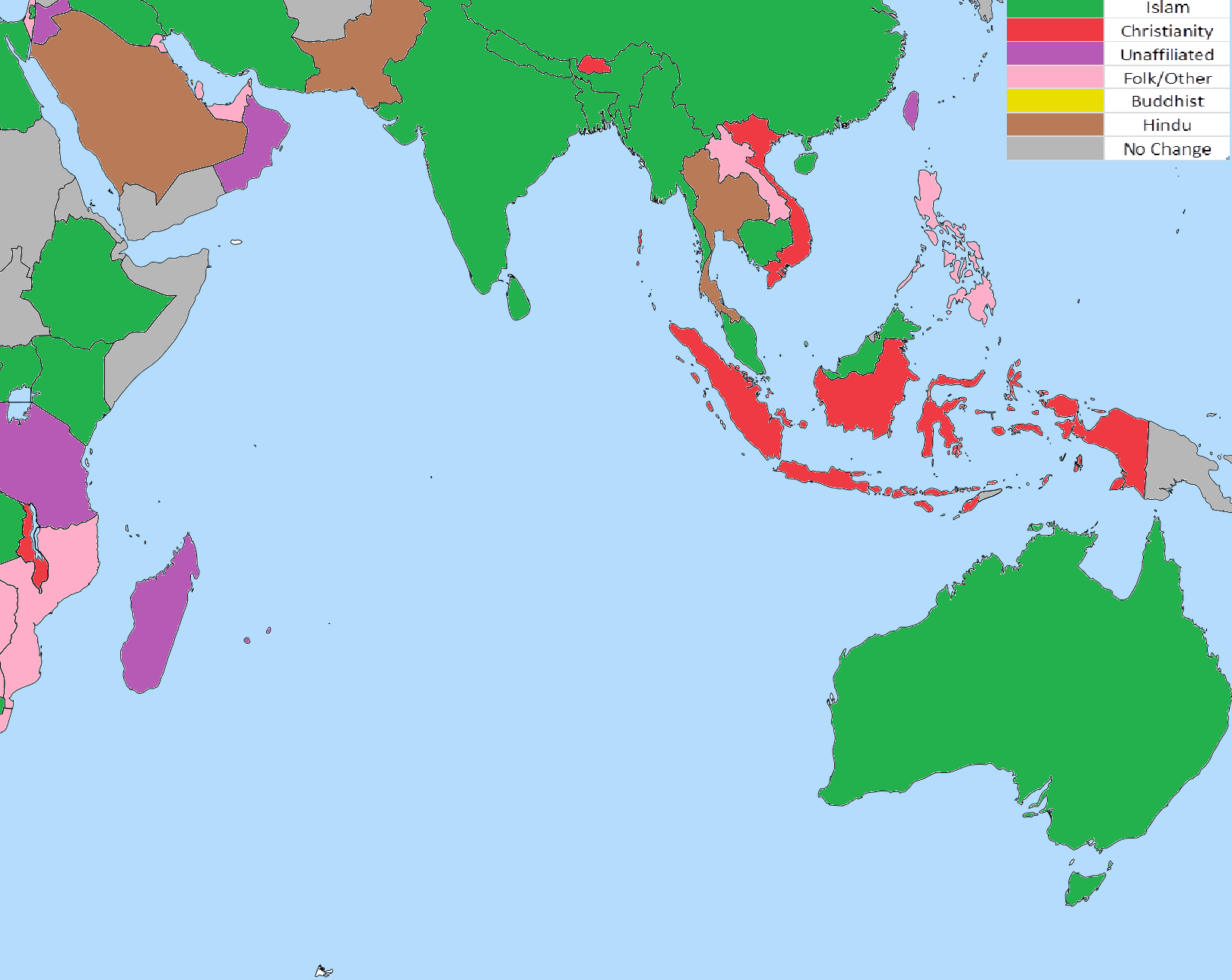
Reddit user KaliKwad took the data from the Pew Research Centre's The Future of World Religions report, and turned it into a map of the world's fastest-growing religions.

Relative numbers


The map is based on relative, not absolute, numbers, so the religion picked is the one that will have the biggest jump in its share of each country's population. As an example, Islam happens to be the fastest growing religion in India, but its relative share of the total population is only going from 14.4% to 18.4% by 2050, not even coming close to challenging Hinduism's hold on the nation.

With that caveat aside, here is the map for Asia.

Kalikwad/Reddit

As is evident, Islam is growing fast everywhere. The report in fact predicts that, by 2050, Muslims will surpass Hindus as the largest religious group in the India-Pacific region from having just 24.3% share of the population up to nearly 30% mid-way through the century.

But Hinduism is also growing in unusual places. Again, remember, its relative growth outside India is tiny in absolute numbers – but that still means there are some countries that will have double the number of Hindus by 2050 than they did in 2010. In Saudi Arabia, Hindus currently make up about 1.1% of the population, a number that is expected to go up to 1.6% by 2050, largely on the back of migration. The report suggests nearly 1 million Hindus are expected to move to a different region over the next four decades.

The growth in Pakistan, however, is a slightly different matter and, ironically, is the result of a metric that often turns into an allegation in India: the fertility rate of Hindus. While the fertility rate of all religions globally is about 2.5 children per woman, and just 2.1 in the Asia-Pacific region, the Hindu fertility rate in Pakistan is 3.2, which happens to be the exact same as the Muslim fertility rate in India.

The third country in Asia where Hinduism is growing is Thailand, where it is slated to go up from 0.1% of the Thai population to 0.2% by 2050.

Europe happens to be even more interesting, for Hindus.

Kalikwad/Reddit

The four countries that turn up here are Ireland, Belgium, Italy and Greece, all places where Hindus are expected to grow primarily because of migration and the resulting fertility rate. This becomes even more significant because of Europe's population will actually be contracting by about 6% over the next 40 years, making the Hindu growth of 93% seem much larger even if the absolute numbers end up being still very small.

Buddhism, another religion that originates in India, is also growing tremendously quickly in parts of Europe, taking the top spot in Norway, Sweden, the Netherlands and Austria.
at 04:02 No comments:
Email ThisBlogThis!Share to XShare to FacebookShare to Pinterest

Hinduism growing in Africa

Hinduism growing in Africa without Proselytizing


Interestingly, Hinduism is the fastest growing religion in Ghana.  And no one is involved in the business of converting anyone.  Kwesi Anamoah, national president of the African Hindu Temple,discusses the spread of Hinduism within Ghana.


“Today, there are 2,000 to 3,000 families worshipping all over the country which is a big increase from the 24 people who participated in the first-ever training camp in 1976 to become disciples.  We have not achieved this through the winning of souls as other religions do, but have attracted people into the practice of Hinduism simply by the lives we lead.  Our lives shine in the community to attract people.”
Ghana’s 24 million population is primarily Christian (70%) and second most prevalent religious group is the Muslims. In an interesting paper ‘Returning to Our Spiritual Roots’: African Hindus in Ghana Negotiating Religious Space and Identity by Rev.Abamfo Ofori Atiemo, the writer discusses the spread of Hinduism and the form that it will take as it spreads and adapts to the local culture and historical milieu.  Here is the abstract from his paper:
 Hinduism, in its contemporary transnational form, has been widely noted as a phenomenon present in America, Europe and other parts of the world, including Africa, especially, East and South Africa. Discussions of the phenomenon with regard to Africa have, generally, focused on the Indian Diaspora. However, the developments that occurred in the 19th and the 20th Centuries, which resulted in the growth and spread of Hinduism through its reform movements in India and the Western world, also affected West Africa. The impact of these developments was not restricted to Indian migrants in the region; it extended to the indigenous Africans as well.  In Ghana, for example, there are indigenous Africans who identify with Hinduism, professing and practising it as their own religion. Several Hindu movements have been established in the country. They include the Divine Life Society, the International Society for Krishna Consciousness (ISKCON), Brahma Kumaris and Sri Satya Sai Baba. There are also movements of Buddhist and Sikh origins such as the Maha Bodhi, Nichiren Shoshu, the Soka Gakkai and Guru Nanak. The presence of these traditions has significantly changed the religious landscape of the country. Previously, the religious space was occupied by only three traditions – the indigenous religions, Christianity and Islam.
All the movements of Asian origins have, to different degrees of success, attracted indigenous Ghanaians.  The Hindu groups appear the most successful.  For example, the International Society for Krishna Consciousness (ISKCON) has established a number of branches, and runs a basic school that is well-patronised by both Hindus and non-Hindus. There is also a Hindu Monastery of Africa (HMA), headed by an African Swami, who studied Vedanta at the Forest Academy of the Shivananda Ashram in Rishikesh, India. The latter has established more than seven branches throughout the country and two other branches in neighbouring Togo and the Ivory Coast. In 2010, it was reckoned that there were more than twenty thousand Hindus in Ghana, out which a little over two thousand were Indian migrants.
In this paper, I examine the phenomenon of the ‘African Hindu’ within the context of current discussions about the so-called ‘neo-Hinduism’ and ‘transnational Hinduism.’ I also discuss how these African Hindus resort to a reinterpretation of the history of their traditional religion and culture, in their attempt to find religious space in the almost choked religious environment of Ghana and, also, how they attempt to negotiate their new religious identity in relation to their identity as Africans (Ghanaians). I conclude with a prognosis of the form that Hinduism   is likely to assume in the near future on Ghanaian soil as its African converts attempt to live their faith in the context of their local culture.
at 03:48 No comments:
Email ThisBlogThis!Share to XShare to FacebookShare to Pinterest
Labels: Hinduism growing in Africa

  1. India owes its tolerance to Hindu dharma


  2. hindutolerance


India has been primarily Hindu in terms of culture and religion for many centuries, extending to thousands of years. Hinduism has endured remarkably through long periods of foreign invasion and hostile rule, though other ancient religions have long since perished.

We find this vast spiritual and cultural tradition comprehensively explained as early as the Mahabharata, and synthesised philosophically in the Bhagavad Gita more than 2,000 years ago. The Mahabharata describes the geography of the entire subcontinent of India relative to the worship of Krishna, Rama, Vishnu, Shiva and Durga, explaining the main deity forms and yogic teachings of later Hinduism, as well as delineating the rule of kings. Other important dharmic traditions, notably Buddhism and Jainism, share a common culture, values and practices with the Hindu.

Christianity arrived in India at an early period but was a minor influence until the colonial period. Islam began inroads in the eighth century and become a strong force after the thirteenth century. Yet these religions, in spite of great efforts, could not replace Hinduism as the dominant cultural tradition.

Composite culture and cultural continuity

Culture has an identity and continuity that evolves over time. In this regard, we can speak of an Indian culture and identity that is predominantly Hindu, just as we can speak of a European culture and identity that is predominantly Judeo-Christian, or a Middle Eastern culture that is predominantly Islamic.

There is certainly much beautiful art, profound philosophy, transformative yoga practices and deep experiential spirituality in Hindu and related dharmic traditions. This ancient dharmic culture spread to East Asia, Indochina and Indonesia, but also to Central Asia and influenced West Asia and Europe.

Yet Hindu dharma has not been frozen in time and continues to assimilate not only other religions, but also science, democracy and other modern trends, without losing its identity as promoting the spiritual quest above outer forms or dogmas.

It is crucial that India recognises its past, which has a strong Hindu component, in order to understand its cultural heritage. There may be aspects of older traditions that are not politically or scientifically correct in terms of current standards or may need reform, just as is the case with older cultures of the world. But there is much of tremendous value that should not be forgotten.

The fear of Hindu majoritarianism


There is a fear in India that highlighting its Hindu past may alienate non-Hindus or make Hindus intolerant today. There is a fear of Hindu majoritarianism in India, just as there isa fear of Christian majoritarianism in the West, or Islamic majoritarianism in the Middle East.

Yet Hinduism has never had a single book, church, or religious law, nor any single savior or religious leader. It recognises that the Divine dwells in the hearts of all beings as the very power of consciousness. Its views of religion and culture are pluralistic and synthetic, not exclusivist or monolithic. Hinduism has not been an aggressive religion, but one often under siege owing to its emphasis on inner spiritual practice over seeking power in the external world.

The British tried to eradicate pride in India’s past through denigrating Hindu teachings starting with the Vedas. Though they preserved certain Sanskrit texts, their interpretations were condescending and inaccurate. Marxist and Freudian scholars have continued with demeaning interpretations of Hinduism and miss its sublime art and spirituality.

The great gurus of modern India since Vivekananda have kept the teachings alive and expanding in spite of such concerted efforts that have even targeted them personally.

India’s characteristic culture and yogic spirituality that the world honours owes a great deal to its Hindu background. India has more peace and tolerance today than Pakistan and Bangladesh that have rejected their Hindu past and where the percentage of Hindus in the country has been radically reduced. Muslims have greater religious freedom in India than in Pakistan, with Islamic groups like Shias and Ahmadiyyas that are often attacked in Pakistan able to operate freely in India.

Mahatma Gandhi referred to himself as a “proud Hindu”. Yet such a term will rarely be found repeated in media and academic circles in the country today.

Hindu dharma has supported the timeless spirit of India and should be respected for its role. Hinduism remains one of the greatest cultural, religious and spiritual traditions in the world. An India without Hindu dharma would not be India.
at 00:27 No comments:
Email ThisBlogThis!Share to XShare to FacebookShare to Pinterest

Why we must honour Goddess Saraswati


  1. Goddess of knowledge and education Maa Saraswati Wallpaper

The Veda Mata holds the pure white light of spiritual knowledge and all the rainbow colours of artistic expression.

The following article by Dr David Frawley was first published by DailyO


The image of the feminine muse who inspires the poet with her beauty and her grace is a common theme in great poetry, from India and Persia to Greece and Rome, and modern Europe. Sometimes the muse is human but most often she is an artistic personification, extending to an angel or a goddess.

The idea of wisdom as a feminine principle is also common, whether as Sophia of the Christians, Prajna of the Buddhists, or Medha of the Hindus. Only where this feminine power of creativity and receptivity is honoured can either great art or profound mysticism flourish.

In India this cosmic feminine force has probably been granted her widest expression – in every aspect of the feminine human life from child and daughter, to wife, mother and grandmother, and throughout nature as the rivers, lakes, valleys, moon and flowers. She is called devi or the goddess and Hindu temples abound with her many forms and dances.

Saraswati from Vedic times

Saraswati represents vak or the divine word, but the same inspiration she reflects extends to all Hindu goddesses as arising from chit-shakti, the power of consciousness.

Saraswati is the most lauded goddess of the Vedas as Veda Mata, the mother of Vedic knowledge and all the Vedic deities. Saraswati was also the name of the vast river in northwest India on which the ancient Aryas cultivated the inner divine light through fire rituals and deep meditation.

Saraswati plays the veena, the symbol of divine music, holding the book of inner knowledge and the mala as the power of mantra. She has a charming human form, diversely portrayed in painting and sculpture throughout the centuries. She rides the swan of elegant movement, or the peacock that reveals an unbounded creativity arising from a unitary inner vision.

Saraswati means “she who abounds in wide currents and lakes”. She represents the lake of the still and peaceful mind, on which the lotuses of meditation open. Sarasvati is Rasavati or the one who holds the rasa, the inner essence of delight. She directs to look behind the outer forms of the world to the inner message of bliss or ananda.

In Hindu thought, the entire universe arises from, abides in and returns to ananda. The image of Saraswati reminds us that the pursuit of ananda is the highest form of culture and the real purpose of our embodied existence.

Saraswati Puja and Basant Panchami

Saraswati is honoured on the date of Basant Panchami, a celebration of the beauty of springtime. The fifth day of the waxing moon proclaims the growing light of life. Hers is a festival of learning, not as mere memorisation but as an irrepressible overflowing of the joy of awareness.

Worshiping Saraswati may be as simple as honouring one’s school books and educational tools, or children taking Saraswati dolls to school, such as occurs most often in the east of the country. These innocent forms of worship elevate the mind and heart, quite unlike the commercial toys of modern culture.

Sarasvati Puja includes formal rituals and temple worship on a larger scale as well. It is an honouring of inner calm and wisdom, encouraging us to be sensitive, compassionate and attuned to the whole of life.

In India, there has never been the sharp division of the sacred and the profane such as occurred in the West that has kept the spiritual and artistic realms apart.

Saraswati holds at once the pure white light of spiritual knowledge and all the rainbow colours of artistic expression. She represents the dance of nature as a spiritual effulgence. The inability to see the divine iconic light through an artistic image shows a limited perception. We should welcome and celebrate the full divine flow of grace!
at 00:24 No comments:
Email ThisBlogThis!Share to XShare to FacebookShare to Pinterest

The Spirit Matters interviews Dr David Frawley


The spiritual landscape has never been more diverse, more eclectic, more individualized or more internally focused. Spirit matters, and in our open-source world, matters of the spirit are complex and endlessly fascinating. The Spirit Matters podcast aims to help listeners make sense of it all. For more info visit http://spiritmatterstalk.com/dr-david-frawley/


Share this:

  • Share
Po
at 00:22 No comments:
Email ThisBlogThis!Share to XShare to FacebookShare to Pinterest

Saturday, 20 February 2016


How counting your karma can transform your life


  1. karma
The following article by Dr David Frawley (Pandit Vamadeva Shastri) was first published by DailyO
An acceptance of our karmic responsibility in life allows us to act with clarity and integrity.
People all over the world speak about karma, relative to their own lives or the condition of society, just as many practice yoga. Yet a true understanding of karma is rare.

Karma refers to something one has done, a deed. Karma also indicates the long-term consequences of our actions. An action is like an arrow that is shot. Once a deed is done, its consequences cannot be called back. These long-term effects can be very different from the short-term gains that are the usual focus of our efforts.

Karma is not destiny or fate, with which it is sometimes confused. Karma is a matter of cause and effect; as you sow, so shall you reap. The complication is that our actions do not always bear fruit immediately. Some take years or even lifetimes – so long ago that we may forget what we did in the past that brought us to where we are today.

Karma and personal freedom
The law of karma provides a distinct contrast to modern concepts of personal freedom. Our tendency today is to think that each individual should be free to do what he or she wants. This sounds very liberal but can make us ignore the facts of karma.

We are free to act in life, but we must also face the consequences of our actions. You are free to put your hand into a fire or not, but you are not free to escape getting burned if you do.

Karma, however, is not sin, and does not involve any petty moralism. Yet acting in a way that is harmful to others will naturally bring harm to ourselves by the qualities of the forces set in motion. Karma is not the fiat of some deity but reflects how the interconnected energies of life reverberate.

There are not only consequences to our actions at outer social and personal levels; there are ethical and spiritual implicationsfor our inner being or soul. These inner effects of karma may require that we limit or renounce our desires – something our commercial culture does not encourage. Action done out of desire is not free, but binds us to the external world, and may only increase further desires.


Assuming karmic responsibility

The law of karma means that we as individuals are responsible for who we are, not someone else. Even though the external world influences how we act, we alone are karmically accountable for what we eventually decide to do. We cannot simply play the role of the victim, putting our failures at the doorsteps of other people or society. Excusing the violence done by certain groups under the charge that someone else made them do it also does not work with karma.

An acceptance of our karmic responsibility in life allows us to act with clarity and integrity. It brings more consideration into our behaviour and directs us towards higher values. We live in a universe pervaded by consciousness and have a karmic responsibility to the whole of life. If we fail to acknowledge the karmic implications for what we do, we create unnecessary suffering for everyone.


Going beyond karma

Can one ever go beyond karma? We would all like to do what we want and not suffer any negative consequences. But we cannot escape karma, however much we may wish to. Yet it is possible to transcend karma to a higher awareness. This is what yoga and meditation areabout. Karma Yoga, acting with a sense of service to the whole of life, is the best practice to improve our karma. Meditation helps us understand how karma works and shows us how to become detached from its results.

Today we do not believe in karma as much as we believe in money and power – but this can produce very negative karmas if we are not careful. There are also new karmas in the information-technology era that we must consider. Using the new media has a special karmic responsibility as it can easily promote distortions or proliferate unnecessary desires.

Let us recognise our karmic responsibility as individuals, so that our lives achieve what is truly meaningful for us at a spiritual level. And collectively let us recognise the effect of our actions on future generations, so we do not compromise the resources of life that belong to all.

Do an honest accounting of your karma if you can, not just an assessment of what you may own, know or have achieved. It can be very revealing and transforming.

Learn the wisdom of karma and your life will become an adventure in consciousness.
at 03:50 No comments:
Email ThisBlogThis!Share to XShare to FacebookShare to Pinterest
Newer Posts Older Posts Home
Subscribe to: Posts (Atom)

Featured post

Hinduism growing in Africa

Hinduism growing in Africa without Proselytizing Interestingly, Hinduism is the fastest growing religion in Ghana.  And no one is inv...

Blog Archive

  • ▼  2016 (41)
    • ▼  March (3)
      • World’s largest military medical center offers H...
      • Do you realize now the sacred significance and th...
      • Why Lord Shiva is the ultimate grandmaster of yoga
    • ►  February (23)
    • ►  January (15)
Kesarinews. Picture Window theme. Powered by Blogger.